A New Operating Model to Unlock Human Potential
Legacy HCM was built for a static workforce that no longer exists and the operating model we've lived by needs to change too.

Kelley Steven-Waiss
•
•
3
min read
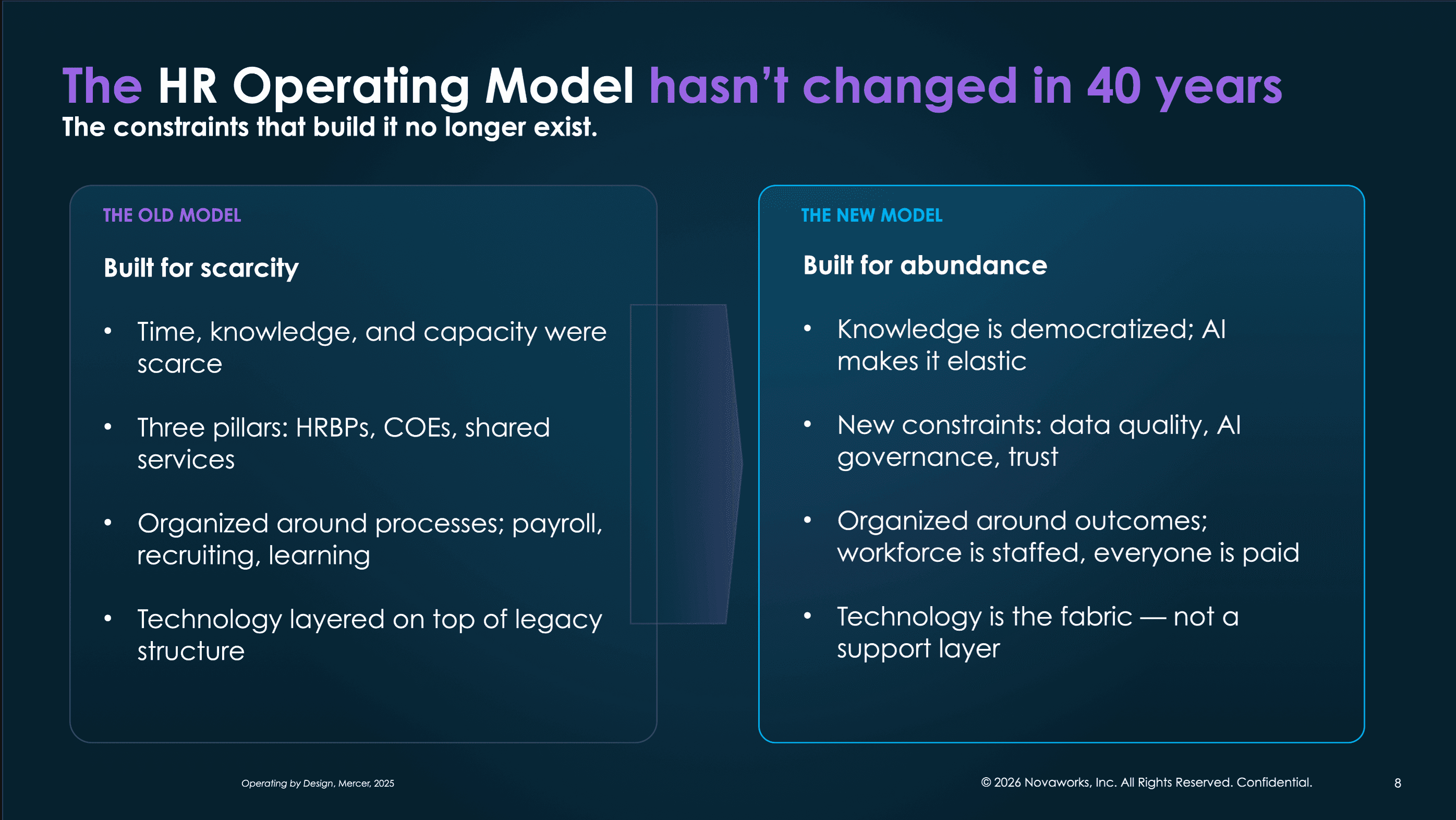
Something I have known for a while is that Legacy Human Capital Management (HCM) systems were built for a static workforce that no longer exists. In addition to this, the operating model we have always espoused to live by also needs to change.
Unfathomable Acceleration
I doubt most people could have predicted the massive disruption that is taking place today across the enterprise even as recently as one year ago. This moment is a confluence of accelerated technology, fueled by AI, the changing needs of global organizations, how they need to operate, and how people actually work.
With the shift to Agentic AI, there is an opportunity to leverage emerging technology to define a new operating model for organizations in how they deploy and manage their total workforce, including employees, contractors, and agents.
Operating models have inputs (culture, core values, vision and strategy) and outputs (business and people outcomes). What comes in between is a well-integrated set of governance principles, leadership capabilities, organizational structure, and accountabilities). This is all underpinned by People, Process, and Technology. With the proliferation of Agentic AI, everyone must address needed changes in the operating model now or face extinction. When HR works closely with IT there is a chance to lead the transformation empowered by a clear vision of how to integrate these three pillars.
Now, we have the technology to make this vision a reality.
Build In, Not Bolt On
What comes next isn’t another piece of HR SaaS bolted onto tech stacks that are already held together by duct tape and prayers in a Frankenstein fashion to retrofit into a legacy foundation and investments that were made not foreseeing the age of Agentic AI. It is entirely within our capabilities to work in parallel with companies to graft, not replace existing systems, which should remove friction in making this decision and driving transformation. Now, it’s not optimization, digitization or evolution. We all need to embrace a ‘beginner’s mindset’ in the way we think about work, and in Novaworks’ view, it's about how HR leaders take the reins and partner with IT to reinvent how the workforce works.
HR and IT can no longer operate in separate lanes. Joint decision rights, shared data, and co-owned roadmaps are now structural requirements, not best practices or the walled gardens of yesterday’s Centers of Excellence. Your platform should be designed to sit at that intersection, not belong exclusively to either function.
For IT leaders, AI governance is now an IT responsibility that HR co-owns. Your platform needs audit trails, explainability, and bias monitoring built in.
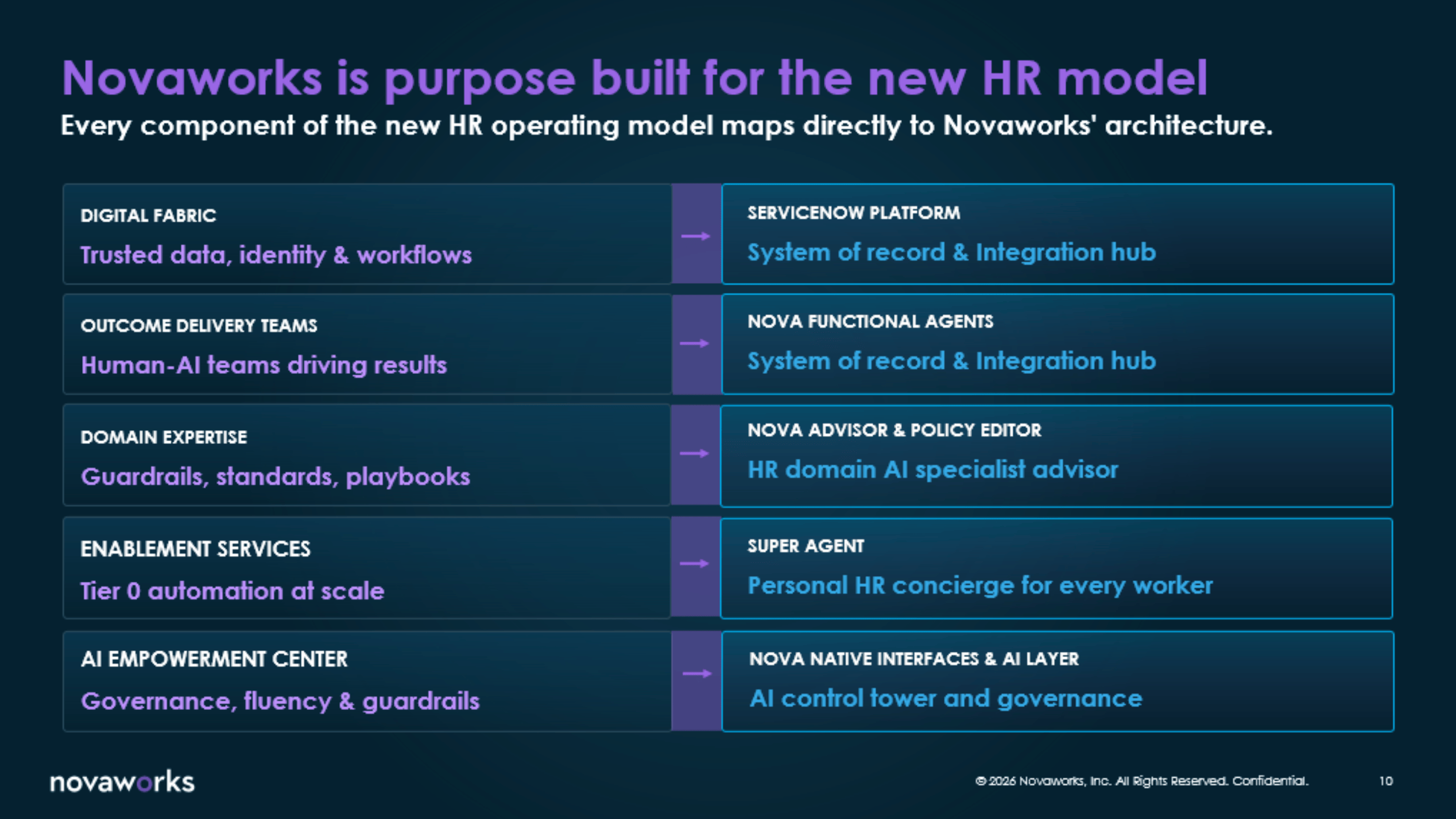
Mercer, a consultancy that helps clients shape the future of work, aptly describes the connective tissue (using the body as the analogy) that integrates people, data, and systems as the ‘digital fabric’ that manages identity, data lineage, privacy, and workflow orchestration. This is essentially the infrastructure layer your HCM platform is, and Mercer is arguing it should be treated as the enterprise's organizing memory, not a back-office system. The implication: your platform shouldn't be one system among many. It should be the authoritative fabric everything else connects to. I agree.
Now what? Ask the Right Questions
The path forward requires new design principles; new ways of working across HR, IT and finance; and a reorientation toward outcome delivery rather than service delivery. What tools do we need to move from static tasks to delivering measurable outcomes? How do we operate from a design principal mindset? For example, try leveraging cross-functional teams embedded in the business, as the primary delivery unit.
The organizations that will win are those that can move from HR as a service-delivery function to HR as an outcome-delivery system and they need a platform built natively for that world. Designing your UX and data model around ODT workflows (outcome ownership, signal monitoring, human-AI task allocation) would be the right move, directionally. The most innovative organizations in 2026 are being structured as hybrid intelligence teams — cross-functional units where humans and AI systems work in complementary roles to achieve outcomes neither could accomplish alone. The companies pulling ahead are organizing differently.
Having spent the bulk of my career as both a CHRO and a transformation leader, I know how daunting it can be to choose to be bold. And, how big the impact can be when organizations get it right. The biggest change in how we do business now is that AI is the greatest forcing function on the planet. And, Novaworks exists to support that leap in the world of work, regardless of function or industry. Agent, or human.
It requires being brave, bold, and accepting that today’s operating systems and underlying tech need reinvention. Are you ready to accept the challenge?
*Reference: Mercer’s 2025 report “Operating by Design POV”